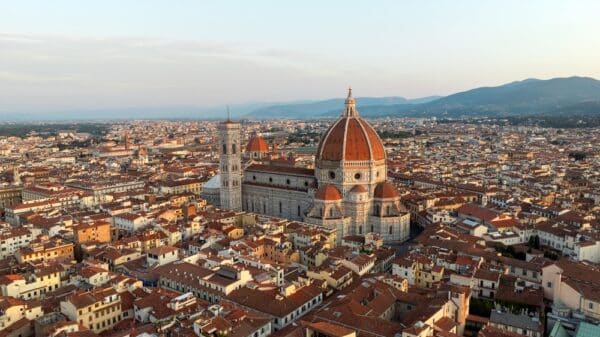









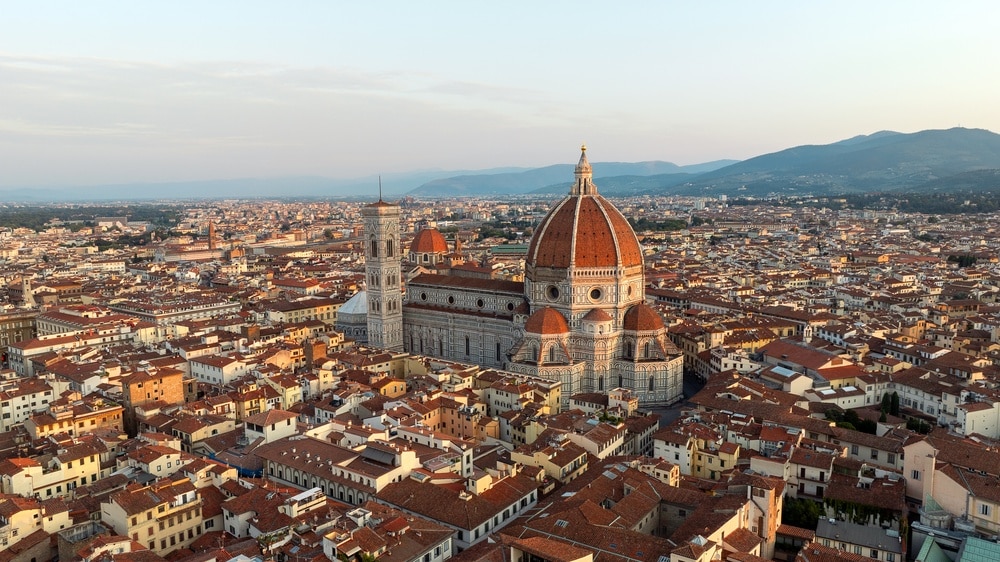
One of the greatest joys of exploring Italy is how seamlessly you can weave the history of the Renaissance into your travel itinerary. Picture yourself staying in a converted sixteenth-century monastery in Florence, located just a short walk from Michelangelo’s iconic David, Brunelleschi’s magnificent cathedral dome, and the resting places of the influential Medici family. That is merely the beginning of what this cultural hub has to offer travelers.
The Dawn of Cultural Humanism
Prior to the Renaissance, Europe experienced roughly a millennium of cultural stagnation. The vast majority of artistic creation existed strictly to serve the Church, casting ordinary human beings in minor roles defined primarily by sin. However, around the year 1400, a dramatic shift began to take shape.
The emerging concept of the “Renaissance Man” meant individuals took charge of their own destinies rather than viewing themselves as passive subjects of supernatural forces. The perceived value of the individual soared, transforming earthly existence from a mere rehearsal for the afterlife into something vibrant and meaningful. This newly minted humanism did not reject God; instead, it championed the idea that the highest form of devotion was to acknowledge and fully utilize the natural talents bestowed by the Creator.
The Interconnected Geniuses of the Fifteenth Century
The creative minds driving the Florentine Renaissance formed an extraordinarily interconnected network. Michelangelo drew creative inspiration from Leonardo da Vinci. Leonardo regularly associated with the political thinker Niccolò Machiavelli, who in turn held the ear of the powerful patron Lorenzo the Magnificent. Lorenzo’s son, Pope Leo X, commissioned major works from Raphael, who famously traded masterpieces with the German artist Albrecht Dürer. Dürer was later influenced by Martin Luther, who was subsequently excommunicated by Pope Leo X—the very same pontiff who had attended school with Michelangelo.
Never before had creators commanded such high levels of financial support, creative freedom, and public acclaim. During the Middle Ages, anonymous artisans produced formulaic religious artifacts in large quantities. In contrast, prominent Renaissance figures attained celebrity status, allowing them to dictate terms and produce art driven by personal inspiration.
Blending Science and Artistic Mastery
Renaissance masters earned their legendary reputations through rigorous discipline, merging creative vision with empirical science. They examined human anatomy with the precision of physicians, observed the natural world like biologists, and applied mathematical principles to master perspective.
Through careful experimentation with perspective, visual art gained a lifelike quality that delivered a powerful psychological impact. For instance, when observing Leonardo’s The Last Supper, viewers may not consciously analyze how the perspective lines pull the eye inward, but those geometric cues subconsciously guide both gaze and emotion straight to the central figure of Christ.
The Iconic Masters: Leonardo, Michelangelo, and Raphael
Leonardo da Vinci—operating as a sculptor, inventor, engineer, and scientist—exemplified the quintessential Renaissance Man. Unbothered by the demands of his financial backers, he frequently left undertakings incomplete whenever a new intellectual curiosity captured his attention. Nevertheless, his surviving notebooks reveal a remarkably inquisitive mind that mapped avian flight, dissected human remains, and studied fluid dynamics.
Michelangelo matched Leonardo’s ingenuity and renown, dividing his time between his native Florence and Rome, where lucrative commissions awaited. Over the course of his extensive career, he executed projects commissioned by nine successive popes.
Though Michelangelo steadfastly considered himself a sculptor rather than a painter, a direct command from Pope Julius II brought him to the Vatican to fresco the Sistine Chapel. That monumental ceiling illustrates the narrative of creation and encapsulates the spirit of humanism, portraying humanity crafted in the divine image and sharing in the glory of the Creator.
Raphael synthesized the balanced elegance of Leonardo with the bold strength of Michelangelo. After spending his early career interacting with his older mentors in Florence, he relocated to Rome.
There, the pontiff commissioned him to decorate the walls of the papal library within the Vatican. His sprawling fresco, the School of Athens, paid tribute to pre-Christian philosophers—a bold departure from traditional ecclesiastical themes. By modeling these classical Greek philosophers after the preeminent artists and intellectuals of his own era, Raphael demonstrated that Renaissance Italians viewed themselves as intellectual equals to the luminaries of the ancient world.
Conclusion
Although the Italian Renaissance eventually faded by the dawn of the seventeenth century, travelers from around the globe had already begun journeying to Italy to admire its peerless artistic legacy. Today, visitors exploring the region continue to build their travel plans around experiencing these enduring masterpieces firsthand.